
— Chelsea plumbing services
Water Leak Detection in Chelsea
Hidden leaks destroy ceilings, floors and neighbour relations. Our Chelsea engineers trace leaks under sinks, behind baths, in risers and under floors with practical, targeted methods — then repair once the source is proven.
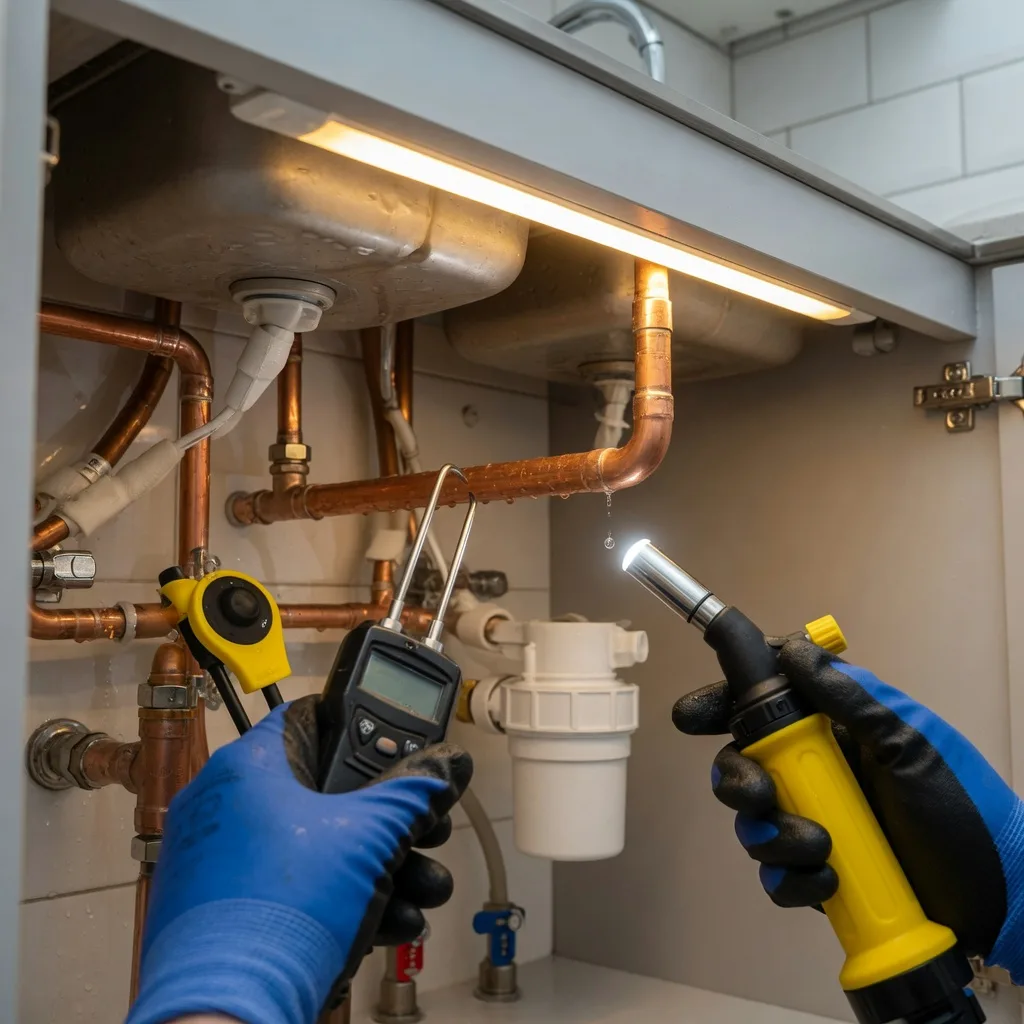
Water leak detection is the process of finding a hidden leak precisely, before you tear anything open, so the repair stays as small as the fault. That distinction matters in Chelsea more than almost anywhere. A slow leak behind a wall, under a solid floor or inside a heating circuit can run for weeks without a single drop appearing in the open, quietly soaking joists, plaster and expensive joinery. Emergency Plumber Chelsea traces these leaks across SW3, SW10 and the surrounding postcodes, then repairs once the source is proven, on 020 3002 6667. Non-invasive detection commonly starts from around £150, and you get a clear price before any work begins.
The earliest sign of a hidden leak is usually a damp patch that has no obvious cause. A shadow spreading across a ceiling, a tide mark low on a wall, a skirting board that stays cold and slightly soft to the touch, or a carpet edge that never quite dries. In older Chelsea houses these marks often appear a floor or two below the actual leak, because water follows joists and pipe runs before it shows itself. The patch you can see is rarely directly beneath the fault, which is exactly why guesswork and random opening of floors so often misses.
A water bill that has crept up for no reason is one of the most reliable warnings of all. If nobody has changed how much water the household uses and the charge keeps rising, water is going somewhere you cannot see. The quickest home check is to close every tap and appliance, then watch the meter: any continued movement with everything off means water is escaping on your side of the supply. Falling pressure at the taps is the same warning from a different angle. When a supply pipe is losing water before it reaches the outlets, flow at a basin or shower weakens, sometimes on one part of the property only, and a system that will not hold its pressure is often bleeding away through a fault you cannot see. We use both of these signals, more precisely, as the starting point of a proper survey rather than as a reason to start lifting boards at random, and we test methodically so a pressure complaint is diagnosed correctly instead of blamed on the wrong fitting. Our guide to reading your water meter shows the overnight test, and why your water bill is so high runs through the other causes.
A musty smell and unexplained mould are the leaks people notice with their nose before their eyes. Persistent damp inside a floor void or wall cavity feeds mould, and Chelsea's period walls, with their lath and plaster and horsehair backing, hold moisture stubbornly. If one corner of a room smells earthy, or black spotting keeps returning to the same patch after you clean it, there is very often a slow leak feeding it. Staining that darkens over days rather than after a single spill tells the same story: a live source, not a one-off accident.
Non-invasive detection matters most in exactly the kind of homes Chelsea is full of. Period and high-value properties are unforgiving of clumsy work: original floorboards, parquet, marble, fine cornicing and bespoke joinery cannot simply be ripped up and replaced like a modern chipboard floor. The whole point of proper leak detection is to protect that fabric. Finding the source to within a small area means the repair opening is small too, so the plasterer, the joiner and the flooring specialist have far less to make good afterwards, and the character of the home survives the repair intact.
Acoustic listening is the first serious tool in most surveys, and it works better than people expect. Water escaping under pressure makes a distinct sound as it forces through a split or a failed joint, and specialist listening equipment picks that up through floors and walls that look completely silent to the ear. By comparing the sound at different points, an engineer narrows a leak from a whole room down to a short run of pipe, then to the joint or split itself. On pressurised supply and rising mains in particular, acoustic tracing is often enough to pinpoint the fault without opening anything at all. It suits Chelsea's solid floors and thick period walls, where a leak can be running well away from where the damp appears and where lifting the wrong board would waste a morning and repair nothing.
Thermal imaging reads temperature rather than sound, which makes it ideal for heating leaks and hot water pipes. A camera that sees heat will show a warm plume spreading from a leaking central heating pipe under a floor, or a cold damp zone where water has soaked into cool plaster. A warm patch on a floor that has no radiator above it is a classic thermal signature of an underfloor heating leak or a buried flow-and-return pipe weeping. Thermal imaging also maps how far damp has travelled, which helps decide where a single, well-placed opening should go.
Tracer gas, moisture meters and pressure testing cover the leaks that stay quiet. Where a leak is too small or too slow to make a useful sound, a safe tracer gas can be introduced into the drained pipework: it escapes at the exact point of failure and is picked up at the surface, giving a pinpoint even on tiny weeps. Moisture meters and probes map the spread of damp through plaster, timber and screed so we can tell wet fabric from dry and follow the trail back toward its source rather than chasing the edges of the stain. Pressure testing then proves whether a pipe is actually losing water and, often, which circuit is at fault: by isolating a section of pipework and monitoring the pressure, an engineer can confirm a leak exists, separate the supply side from the heating side, and rule sound runs in or out. It is the least destructive test of all and frequently the deciding one, turning a vague damp problem into a specific answer about which pipe, on which circuit, is failing, before anyone lifts a single board.
The common sources we find reflect how Chelsea homes are built. Concealed pipework behind period panelling and inside chased walls, heating circuits buried under floors, long under-floor runs in converted flats, failed seals behind baths and showers, weeping joints on the rising main, and the old lead-to-copper joints that still survive in many un-modernised properties. Lead pipe joints in particular fail slowly and quietly as they age, and they are easy to miss without proper tracing. A failed seal behind a bath or wet-room tray can also mimic a pipe leak exactly, sending water into the floor every time the shower runs while the pipework itself tests sound, so distinguishing the two before cutting into tiling saves needless damage. Knowing which of these to suspect in a given building is half the job, and it comes from working in this stock day in, day out. Basement pools and plant rooms are a specialist case of their own, covered in our guide to swimming pool leak detection.
In mansion blocks a hidden leak is rarely a private problem, which raises the stakes on finding it accurately. A slow escape in one flat travels down through the structure and shows up as a stain on a neighbour's ceiling, and the first anyone knows of it is a complaint from the flat below or a call from the managing agent. Detection is what settles who owns the fault: instead of two residents arguing over a damp patch, we trace the source, confirm which flat and which pipe it comes from, and document it so the right party can arrange the repair. Shared risers and stacks that serve several flats make this harder still, because the leaking length may sit behind a cupboard two doors away, and pinpointing it without opening every wall is exactly what non-invasive detection is for. We work with neighbours, porters and managing agents where access to more than one flat is needed, and provide the paperwork that lets a freeholder or block manager act quickly.
Chelsea Harbour and the riverside flats along Chelsea Embankment and Imperial Wharf bring their own detection challenges. Modern apartments run on higher-pressure systems and long concealed pipe routes behind fitted finishes, often over solid floors that cannot simply be lifted. Opening up is expensive and disruptive in a high-specification apartment, so accurate, non-destructive tracing is not a luxury here, it is the only sensible approach. We prioritise acoustic, thermal and pressure methods precisely so the finish stays intact and the repair is confined to the smallest possible area.
Once the leak is found, the work becomes a targeted repair rather than exploratory demolition. Because detection has already told us where the fault is and what has failed, we can open a small, defined area, repair or replace the failed section, and pressure-test the result so you are not calling again in a month. Many faults are fixed on the same visit where parts and access allow; underfloor runs, riser work and anything needing specialist materials are scheduled with the right kit rather than bodged on the spot. We match the repair method to the existing pipework instead of forcing a single approach, so a lead-jointed section, an old copper run and modern plastic each get the right fitting. The aim throughout is the smallest intervention that gives a lasting fix, and pipework left in a state you would be happy to have inspected.
Insurance is where good documentation pays for itself, and this is what trace-and-access means. Many home insurance policies cover the cost of finding a leak and accessing it, not only the repair, but they expect evidence of what was found and where. We provide a plain report of the source, photographs of the fault and the damage, and an itemised invoice that loss adjusters and managing agents accept. Where a claim depends on proving the leak's origin, the detection survey itself becomes the record that supports it, which is often worth far more than the survey costs. Our guide to trace and access cover explains how that part of a policy usually works.
Pricing stays transparent because uncertainty is the thing people dread most about a hidden leak. Non-invasive detection commonly starts from around £150, daytime call-outs start from £69, and nights, weekends and bank holidays start from £89. On arrival the engineer explains what the tests show and quotes the repair before any major work begins, and agreed non-emergency jobs carry no call-out fee. You are never committed to a cost you have not seen, and you are never sold floor-lifting you do not need.
Our coverage is genuinely local across the Chelsea core and its edges. We serve SW3 1 through SW3 6 and all of SW10, including Chelsea Harbour, Worlds End, Lots Road and West Brompton, along with neighbouring SW1W, SW1X, SW5 and SW7. That takes in King's Road, Sloane Square, the Royal Hospital Chelsea, Brompton, the Cadogan Estate streets and the riverside blocks. Every engineer is fully qualified, insured and Gas Safe registered where gas is involved. If a heating leak ever coincides with a smell of gas, leave the property and call the National Gas Emergency Service on 0800 111 999 first, then call us for follow-up.
If you suspect a hidden leak in Chelsea, the sooner it is traced the smaller the damage and the cheaper the repair. A rising bill, a damp patch, a musty corner or a neighbour's complaint is enough reason to have it checked properly rather than watching it spread. Call Emergency Plumber Chelsea on 020 3002 6667, day or night, and we will send an engineer to find the source precisely, explain what it will take to fix, and put it right across SW3, SW10 and the surrounding postcodes, with clear pricing before the work starts. For what a survey involves and what sets the price, see our guide to water leak detection costs in Chelsea.
Common symptoms
- Unexplained high water bill
- Damp patch with no obvious source
- Sound of water when taps are off
- Mould in one corner only
- Neighbour reporting water below your flat
- Warm floor patch on a central heating circuit
What's included
- Visual and instrument-assisted checks
- Isolation and meter tests
- Source identification with plain-English report
- Repair options and quotation
- Same-visit fix where parts and access allow
How water leak detection works in Chelsea
- 01
Call us
Speak to a real person on 020 3002 6667, day or night. Tell us the fault and your postcode.
- 02
Get an ETA
We give you an honest arrival time — 45 to 90 minutes for genuine emergencies across SW3 and SW10.
- 03
Assess & make safe
A Gas Safe registered engineer arrives, isolates the fault and stops the damage, then quotes before major work.
- 04
Fixed & tidy
We complete the repair, test it, and leave your property clean — with an itemised invoice for your records.
Transparent pricing
FAQs
Do you always open floors?
No. We avoid unnecessary opening and only recommend invasive work when justified by the tests.
Can you find leaks between flats?
We regularly investigate inter-floor leaks in Chelsea mansion blocks, working with managing agents and neighbours where access is required.
How much does leak detection cost?
We agree the price before any major work, so you are never committed to a cost you have not seen. Call-outs start from £69 daytime and from £89 at nights, weekends and bank holidays, and there is no call-out fee at all if the job takes over 3 hours.
How quickly can you attend a suspected hidden leak?
For active leaks we target 45 to 90 minutes across SW3 and SW10, subject to traffic and availability. Slow hidden leaks can be booked as a prompt scheduled visit if nothing is actively flooding.
What methods do you use to trace a leak?
We start with the least invasive checks first, such as water meter and isolation tests, toilet overflows, shower trays and accessible pipe runs, and only escalate to focused opening where the evidence points. This protects period floors, plaster and fitted kitchens.
Do you cover my area for leak detection?
Yes. We cover SW3 and SW10 including Chelsea Harbour, Worlds End, Lots Road and West Brompton, plus SW1W, SW1X, SW5 and SW7. Give us your postcode when you call 020 3002 6667.
Do you provide a report for insurance or managing agents?
Yes. You get a plain-English explanation of the source, and we can supply photos and itemised invoices on request for insurers, freeholders and managing agents dealing with an inter-floor leak.
Also see our other Chelsea services: Emergency Plumber Chelsea, 24 Hour Plumber Chelsea, Plumbing Repairs, Plumbing Installation.
Book water leak detection in Chelsea
Call 020 3002 6667 — 24/7 dispatch across SW3, SW10 and nearby postcodes.