
— Chelsea plumbing services
Bathroom Plumber in Chelsea
From a failed cistern at 2am to a planned bathroom refit, Emergency Plumber Chelsea delivers bathroom plumbing across SW3 and SW10 with clean workmanship and clear quotes on 020 3002 6667.
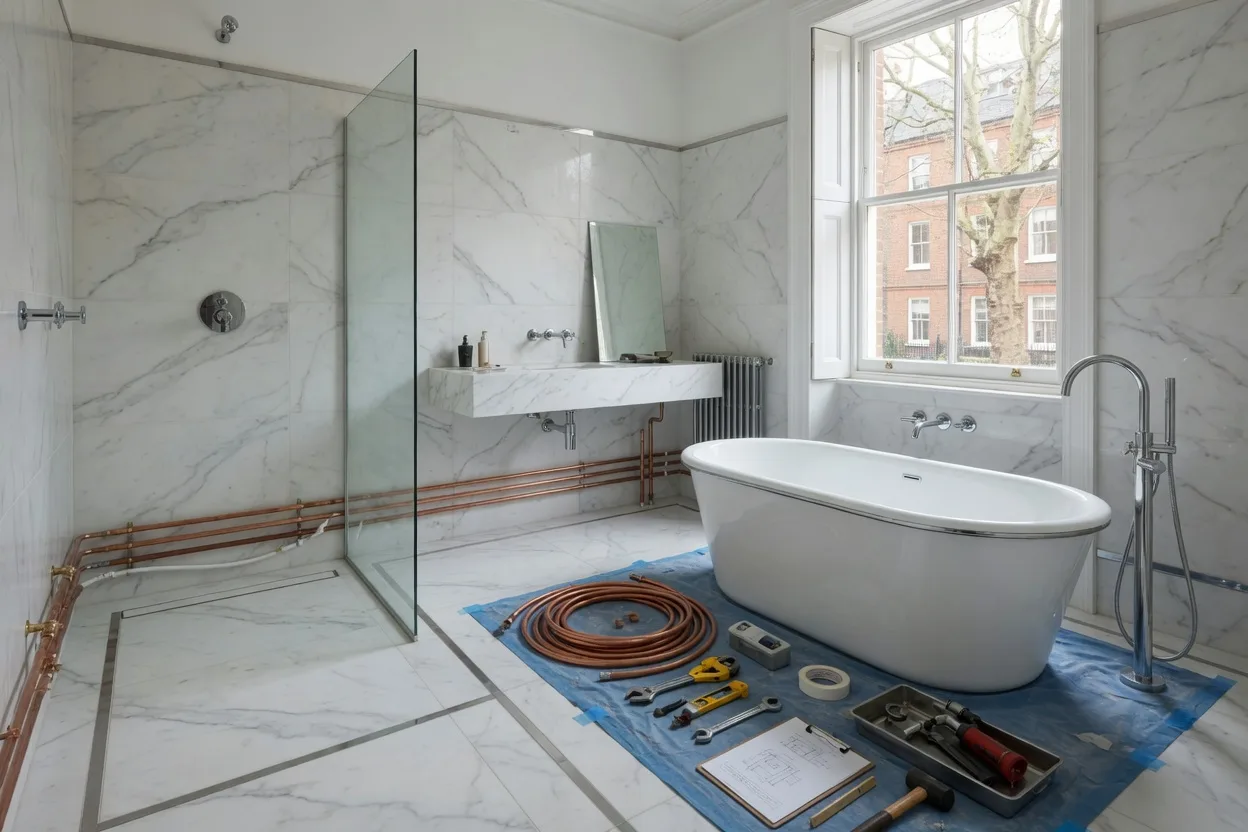
Bathroom plumbing covers everything that carries water into and waste out of the room: basins, baths, showers, WCs and bidets, along with the taps, valves, traps, wastes and concealed pipework that connect them. Emergency Plumber Chelsea repairs, replaces and installs the whole bathroom across SW3, SW10 and the surrounding postcodes, 24 hours a day, on 020 3002 6667. That means a 2am cistern failure or a leaking bath trap gets a make-safe now, and a planned refit gets first-fix and second-fix plumbing booked with fixed pricing. Daytime emergency call-outs start from £69, nights, weekends and bank holidays from £89, and you see the price before any major work begins.
You need a bathroom plumber when water is escaping, a fitting has failed, or you are refitting the room and the pipework has to be moved. The urgent calls are the obvious ones: a basin waste dripping into the cupboard below, a bath overflowing because the trap has come apart, a shower valve stuck open, a WC that will not stop running or has cracked at the pan. The planned calls are quieter but just as important: relocating a soil pipe for a new suite, converting a bathroom into a wet room, or replacing tired sanitaryware before it fails. We handle both ends, so the same engineer who stops tonight's leak can also quote the refit that stops it happening again.
Most bathroom leaks come from a short list of failure points, and identifying which one you have shapes the whole repair. Basin and bath traps work loose or crack and weep at the joint. Flexible tap connectors perish and split, often years after they were fitted. Waste and trap seals dry out and let water past a bath or shower. Cistern inlet and flush valves fail and either run constantly or leak from the base. Silicone around a bath, tray or basin breaks down and lets water track behind tiles and under floors. Concealed pipework and buried isolation valves corrode where you cannot see them. Naming the source precisely is what keeps a bathroom repair small.
The most damaging bathroom leaks are the ones you cannot see, and they matter enormously in Chelsea's layered buildings. Water from a failed shower seal or a weeping concealed elbow does not pool on the floor; it runs along joists, soaks the void under the tray, and shows up as a stain on the ceiling below, often a room or two away from the actual fault. By the time a downstairs cornice is marked, the timber above it has usually been wet for weeks. Where the source is not obvious we trace it with moisture and acoustic methods rather than opening tiles and boxing at random, so we lift the smallest possible area of a finished bathroom to reach the failed part.
Silicone and sealant do far more work in a bathroom than they get credit for, and failed sealant is behind a surprising number of ceiling leaks. The bead where a bath meets the wall, around a shower tray, behind a basin and along a wet-room upstand is the barrier that keeps splashing water out of the structure. When it shrinks, lifts or goes mouldy it stops sealing, and water runs behind the tile line into the wall and floor. We cut out tired silicone properly, let the surfaces dry, and reseal with a sanitary-grade product that resists mould, rather than smearing fresh sealant over old. On a wet room the waterproof tanking under the tiles is the real defence, and we flag where that has been compromised rather than just re-doing the surface.
Chelsea bathrooms fall into two broad worlds, and each plumbs differently. Period Victorian and Georgian houses off the King's Road and around the Cadogan Estate streets tend to have bathrooms squeezed into former bedrooms or returns, with waste runs threaded through original joists, concealed pipework behind lath-and-plaster, and sometimes surviving lead on older sections. High-spec modern suites in the same postcodes, and the riverside apartments at Chelsea Harbour and Imperial Wharf, run higher-pressure systems, concealed cistern frames, thermostatic valves and designer sanitaryware where a single component can be expensive and specific. An engineer who knows both diagnoses faster and avoids the guesswork that turns a short visit into a long one.
Working in a high-end Chelsea bathroom is as much about protecting finishes as fixing pipes. Marble, natural stone, hand-made tiles, chrome and brushed brass fittings, and fitted furniture all mark or scratch easily, and replacement can take weeks to source. We work over the finished surfaces, isolate the right feed rather than draining the whole property, and open concealed panels and access hatches properly instead of cutting where it will show. Where a designer mixer, a concealed cistern frame or a wall-hung pan is involved, matching the existing part or a genuine equivalent matters, because a mismatched valve or flush plate looks wrong in a room that was expensive to fit. Careful work here is what keeps a repair invisible once it is done.
Bathrooms on upper floors and in mansion blocks carry a risk that a ground-floor bathroom does not: the flat below. A leak from a bath, WC or concealed waste on the second or third floor travels down through the structure and becomes a neighbour's problem, and in a red-brick mansion block off Sloane Square or along Chelsea Embankment that neighbour is often a leaseholder with their own insurer. We isolate the source first to stop it, then help establish what failed and where, so both parties, the managing agent and the freeholder are dealing with facts rather than blame. Getting to the fault quickly, and documenting it clearly, is what stops one loose trap turning into a drawn-out dispute between flats.
When our engineer arrives for a bathroom emergency, the first job is to make it safe before opening anything up. We isolate the relevant supply, ideally at the local stop tap or isolation valve serving the bathroom rather than the whole flat, relieve the pressure, and stop water reaching floors, ceilings and anything electric such as a shaver socket, extractor or underfloor heating. Many older Chelsea bathrooms have seized or missing isolation valves, which is exactly why a small hose failure floods a cupboard; where that is the case we free or replace the valve as part of the visit. Once the room is stable and you have agreed the price, the permanent repair follows.
There are useful things you can do in the minutes before we arrive, and they genuinely reduce the damage. If there is a working isolation valve under the basin, behind the WC or on the bath feed, turn it clockwise to close it; if not, shut the main stopcock, usually under the kitchen sink, in a hall cupboard or near the front door in a converted flat. Open the bath or basin cold tap briefly to drain pressure from the run. Lift towels, bath mats and anything on the floor clear of the water, put a bucket under an active drip, and if water is anywhere near a socket or the extractor and you can reach the consumer unit from a dry position, switch off the electrics. Photograph the scene for your insurer while you wait.
Bathroom installations are where careful plumbing quietly saves you money later, so we sequence them properly. First-fix is the pipework and waste runs set out and pressure-checked before the tiler and plasterer close the walls and floor, positioned so a wall-hung basin, a back-to-wall WC or a walk-in shower sits exactly where the design wants it. Second-fix is fitting the sanitaryware, taps, valves, wastes and traps once the room is decorated, then testing every joint under pressure. We coordinate with your builder, tiler and decorator so the plumbing arrives on the right day rather than holding up the trade behind it, and we set falls and waste positions correctly so a new shower or wet room actually drains instead of pooling.
Wet rooms deserve particular care because they remove the tray that would otherwise contain a leak. A wet room relies on a level floor, a correctly set drain and gully, and continuous waterproof tanking under the tiles, all of which have to be right before a single tile goes down. Get the falls wrong and water sits; get the tanking wrong and it finds the joists below, which in an upper-floor Chelsea flat means the ceiling underneath. We plumb the drain to the correct fall, connect it to a properly vented waste, and make sure the waterproofing detail around the drain and the walls is sound, so the finished room looks seamless and stays dry underneath. It is a build where the plumbing you cannot see matters more than the tiling you can.
Chelsea's hard water is a slow, steady enemy of bathroom fittings, and it shapes what we recommend. Limescale furs up shower valves, stiffens tap cartridges, blocks the small waterways in thermostatic mixers and crusts around wastes and spray heads, so components that would last a decade in soft-water areas fail sooner here. When we replace a valve, tap or cistern part we fit quality components that stand up to scale rather than the cheapest equivalent, and we can advise on descaling and on whether a scale-reducing measure is worth it for a particular bathroom. Choosing durable sanitaryware and valves at the point of repair or installation is cheap insurance against another call-out in a couple of years.
Because so much of Chelsea is leasehold, the paperwork around a bathroom job often matters as much as the pipework. A bathroom leak in a mansion block or managed conversion frequently involves the flat below, the managing agent, the freeholder and two insurers, and a clean record is what keeps the claim simple. On request we photograph the failure and the damage, note the cause and the repair, and provide an itemised invoice that landlords, managing agents and insurers accept for escape-of-water claims. For a leasehold flat we can set out plainly whether the failure was on demised pipework inside the flat or on a communal run, which often decides who pays. We also work within the relevant water and building regulations, and keep pipe routes discreet in period and listed properties.
Bathroom plumbing pricing is kept transparent because a flooded bathroom is stressful enough without a surprise bill. Daytime emergency call-outs start from £69, nights, weekends and bank holidays from £89, and the engineer assesses the fault on arrival and gives you a price, itemised or fixed, before any major work starts; agreed non-emergency jobs and planned installations carry no call-out fee. Our engineers are fully qualified, insured and Gas Safe registered where any gas work is involved, though most bathroom plumbing is not gas work. If you ever smell gas, leave the property and call the National Gas Emergency Service on 0800 111 999 first, then call us for follow-up once it is safe.
Our bathroom plumbing coverage is genuinely local across the Chelsea core, so an engineer is not crawling in from miles away while your ceiling stains. We cover SW3 1 through SW3 6 and all of SW10, including Chelsea Harbour, Worlds End, Lots Road and West Brompton, along with neighbouring SW1W, SW1X, SW5 and SW7, taking in King's Road, Sloane Square, the Royal Hospital Chelsea, Brompton, the Cadogan Estate streets and the riverside blocks along Chelsea Embankment and Imperial Wharf. Whether a bath is leaking through to the flat below right now or you are planning a full refit, isolate the water if you safely can and call Emergency Plumber Chelsea on 020 3002 6667. We answer 24 hours a day, give you a real arrival time, and send an engineer who can make safe, repair or install with clear pricing before the work starts.
Common symptoms
- Running or overflowing toilet cistern
- Leaking shower tray or enclosure seals
- No water to basin or bath
- Seized stop taps under sanitaryware
- Failed thermostatic mixer valve
- Loose or rocking WC pan
What's included
- Emergency make-safe isolation
- Repairs and like-for-like replacements
- Shower valve and tray plumbing
- Full bathroom first and second fix
- Coordination with builders where required
How bathroom plumbing works in Chelsea
- 01
Call us
Speak to a real person on 020 3002 6667, day or night. Tell us the fault and your postcode.
- 02
Get an ETA
We give you an honest arrival time — 45 to 90 minutes for genuine emergencies across SW3 and SW10.
- 03
Assess & make safe
A Gas Safe registered engineer arrives, isolates the fault and stops the damage, then quotes before major work.
- 04
Fixed & tidy
We complete the repair, test it, and leave your property clean — with an itemised invoice for your records.
Transparent pricing
FAQs
Do you install complete bathrooms?
Yes — plumbing for full bathroom fit-outs, coordinated with your builder if needed across Chelsea refurbishments.
Can you match high-spec sanitaryware?
We regularly fit designer brands. Supply your preferred suite or ask us to recommend durable options suited to Chelsea hard water.
How quickly can a bathroom plumber reach my Chelsea flat?
For genuine emergencies such as a leaking cistern or a shower leaking through a ceiling, we aim to attend across SW3 and SW10 within 45 to 90 minutes, subject to traffic. Call 020 3002 6667 and you will get a real arrival time.
Are you available for bathroom emergencies at night and weekends?
Yes, our line is answered 24 hours a day on 020 3002 6667, including nights, weekends and bank holidays. A failed cistern or a leaking tray at 2am gets a proper engineer, not a morning callback.
What does a bathroom plumbing call-out cost?
Emergency call-outs start from 69 pounds daytime and from 89 pounds at nights, weekends and bank holidays. There is no call-out fee on agreed non-emergency jobs, and none at all if the job runs over 3 hours. The price is agreed before any major work starts.
Do you cover my area for bathroom work?
We cover SW3 (SW3 1 to 6) and all of SW10 including Chelsea Harbour, Worlds End, Lots Road and West Brompton, plus SW1W, SW1X, SW5 and SW7. If you are unsure, call 020 3002 6667 and we will confirm.
Can you provide an invoice for my managing agent or insurer?
Yes. We provide itemised invoices with notes and photographs on request, which landlords, managing agents and insurers accept for compliance files and claims on Chelsea leasehold flats.
Also see our other Chelsea services: Emergency Plumber Chelsea, 24 Hour Plumber Chelsea, Plumbing Repairs, Plumbing Installation.
Book bathroom plumbing in Chelsea
Call 020 3002 6667 — 24/7 dispatch across SW3, SW10 and nearby postcodes.