
— Chelsea plumbing services
CCTV Drain Survey in Chelsea
Guessing at underground faults wastes money. A CCTV drain survey shows collapses, roots, scale and poor joints so repairs are targeted — essential for recurring blockages in Chelsea properties.
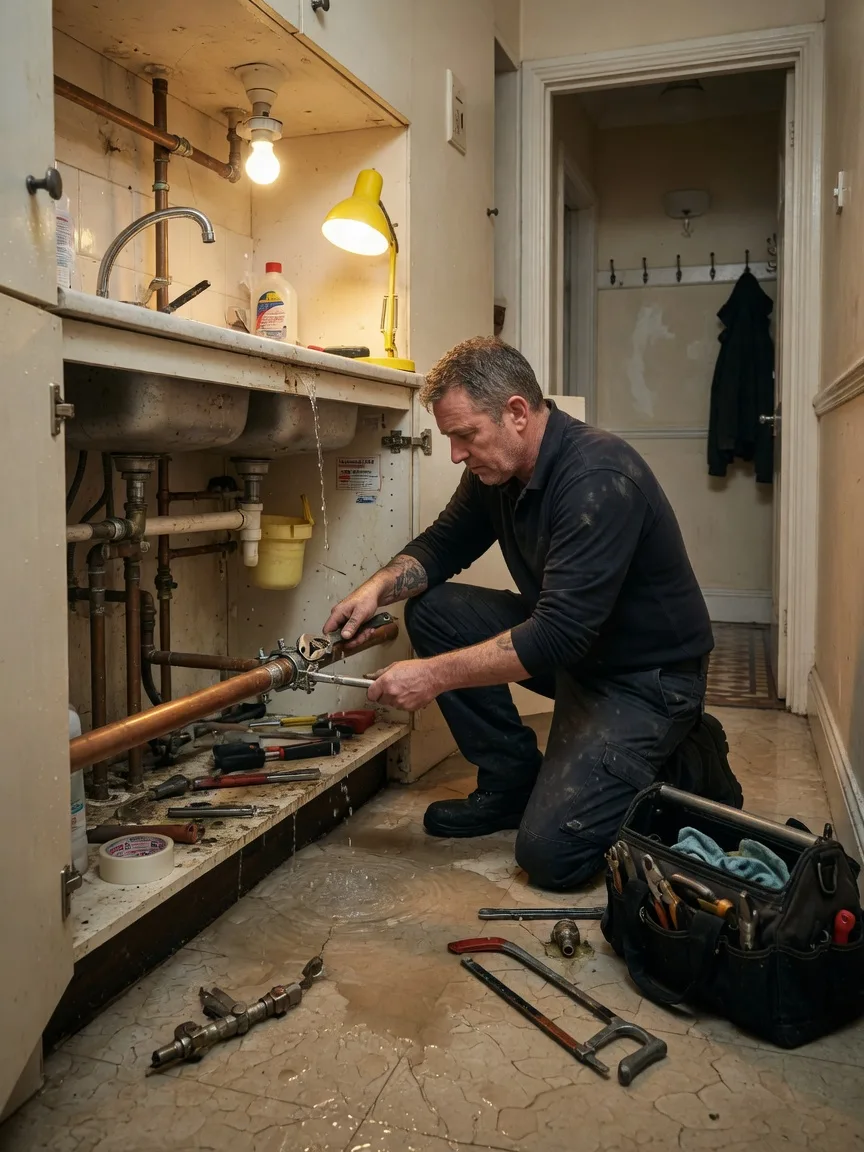
A CCTV drain survey is a diagnostic inspection: an engineer feeds a waterproof camera through your drain runs, records the footage, and reads the pipe from the inside so the real cause of a fault is identified before anyone digs or quotes for repairs. Emergency Plumber Chelsea carries out camera surveys across SW3, SW10 and the surrounding postcodes on 020 3002 6667, and the point of the visit is information rather than clearance. You come away knowing what is wrong, where it is, how bad it is, and which repair the drain actually needs, instead of paying to open a trench on a guess. In a Chelsea property, where a single misjudged excavation can mean lifting a tiled kitchen floor or a paved courtyard, that certainty is worth having.
You need a survey when a drain keeps failing and nobody can say why. If a run blocks, gets cleared, and blocks again within weeks, the clearance is treating a symptom while the underlying defect stays put; the camera finds the cause. Recurring backups, foul smells with no obvious source, gurgling waste, damp or staining near a drain line, and localised subsidence or a sinking patch of garden or paving are all reasons to look inside rather than keep rodding. A survey is also the standard next step after two or three emergency clears that never lasted, because at that point you are spending on relief without ever addressing the fault feeding it.
Pre-purchase due diligence is one of the most common reasons Chelsea buyers commission a survey, and it is money well spent on a period home. A homebuyer or building survey rarely covers underground drainage in any detail, so a separate CCTV survey tells you whether the drains under a Victorian or Georgian house are sound or carrying a collapse, root ingress or decades of patched joints that the next owner inherits. On a property costing what Chelsea properties cost, the survey is a small fraction of the price and can either reassure you or give you a concrete figure to negotiate against. Ordering one before exchange, while you still have leverage, is far better than discovering a collapsed drain the first winter after you move in.
Before building work, an extension, or a basement dig, a survey protects both the existing drains and the new plans. Chelsea sees a great deal of basement excavation and rear-extension work, and much of it happens directly over or beside old drain runs whose exact position nobody has recorded. Knowing where the pipes run, what condition they are in, and whether a build will sit on top of them lets you design around the drainage rather than damage it and pay twice. Where a drain will be built over, a survey gives you the evidence a build-over agreement and building control will want, and it flags any run that should be diverted or upgraded before the foundations go in rather than after.
Insurance claims and shared-drain disputes are the other situations where survey footage earns its keep. If you are claiming for escape of water, subsidence or drainage damage, insurers want evidence of the cause and location, and recorded camera footage is exactly the kind of proof they accept. In leasehold mansion blocks and converted houses, where a drain may be shared between several flats or sit on the boundary between two freeholds, a survey establishes where the defect actually is, which usually decides who pays. Rather than neighbours and managing agents arguing over a blockage nobody can see, the footage shows the fault and its position, and the conversation moves from opinion to fact.
The survey shows the full range of drain defects, and each one points to a different repair. Cracks and fractures let water escape and ground in; a full collapse crushes the bore and stops flow entirely; root ingress from nearby trees pushes fine roots through joints and gradually chokes the pipe; displaced or open joints let the sections drift out of line and snag debris. The camera also shows scale and hardened grease build-up, silt and standing water where a run has lost its fall, and misconnections where a waste pipe has been plumbed into the wrong drain. Seeing which of these you are dealing with is the whole value, because a patch, a re-line, a section replacement and a simple clean are very different jobs at very different prices.
Root ingress deserves particular attention in Chelsea because of the mature street trees and established gardens. The plane trees along many Chelsea streets and the old planting in walled gardens send roots a surprising distance, and they find their way into any joint or hairline crack that weeps moisture. On the camera, root ingress shows as fine white or brown tendrils entering at a joint, sometimes a dense mass that has already caught paper and grease into a blockage. Clearing it gives temporary relief, but the roots return unless the joint they are entering through is repaired or re-lined. The survey is what tells you whether you are looking at a quick cut-and-clear or a joint that needs sealing to keep the roots out for good.
Collapses and displaced joints are the faults that most often explain a drain that will not stay clear. Old clay and pitch-fibre pipework under period Chelsea houses becomes brittle with age; ground movement, heavy loads above, and decades of settlement crack sections and pull joints apart. Once a section drops or a joint opens, the run loses its smooth fall, debris catches at the step, and the drain blocks again within weeks however well it is rodded. The camera shows the exact defect and, with a locator, its depth and position on the surface, so any excavation goes straight to the fault. That is the difference between opening a single slab in a courtyard and digging a trench across it hoping to find the problem.
Every survey produces a report and footage you can keep, use and share. You get the recorded video of the inspected runs, still images of the key defects, and a plain-English written summary that says what was found, where each defect sits, how serious it is, and what we recommend: clean only, patch or localised repair, a section replacement, a re-line, or further investigation where access stopped us short. Where the equipment allows, defects are located to a point and a depth on the surface so a repair crew knows exactly where to work. This is the document buyers hand to solicitors, freeholders send to managing agents, and homeowners give to insurers, and it is written to stand up to all three.
The survey is diagnosis, not clearance or repair, and keeping those separate is what keeps it honest. A camera cannot travel through a drain packed with silt, grease or standing water, so where a line is heavily blocked we usually clear enough for the camera to pass first, then survey the clean line and report on its true condition. The survey itself does not fix anything; it tells you what fixing is needed. This is deliberately different from our drain unblocking and drain repair services: unblocking gets a backed-up drain flowing again, repair puts a defect right, and the survey sits between them, making sure any repair you pay for is aimed at the actual fault rather than a symptom.
How the survey runs on the day depends on access, and Chelsea properties throw up more access challenges than most. We work from the available entry points, usually an inspection chamber, a manhole, a rodding eye or a removed gully or WC connection, and feed the camera along each accessible run in turn. Terraced Victorian houses often share rear drainage down a single line, mansion blocks bury runs beneath communal areas and vaults, and basement conversions can seal old access points behind new floors. Where we cannot reach a section, we say so plainly and note it as a limitation rather than pretending to a complete network map we did not actually see. An honest survey is specific about what was inspected and what was not.
Mansion blocks, leasehold conversions and managing agents shape how a Chelsea survey is arranged as much as the drainage itself. In a red-brick mansion block off Sloane Square or the Cadogan Estate streets, the drains below the building are frequently communal, and reaching the chambers can mean coordinating with a porter, the managing agent or the freeholder for access to a basement or a locked yard. We are used to booking in through the concierge, working cleanly in finished common parts, and producing a report the block's managing agent can act on. Where a fault sits on a shared run rather than a single flat's demised pipework, the footage makes that clear, which is exactly what a leasehold building needs to settle who is responsible for the repair.
Riverside and modern flats bring different drainage from the period houses, and the survey reflects that. Apartments at Chelsea Harbour and Imperial Wharf, and the newer blocks near Lots Road and along Chelsea Embankment, tend to have more modern pipework and pumped or shared systems, with runs concealed above ceilings and below floor screeds rather than in a back garden. Access is often through communal risers and plant areas, parking is restricted, and lifts slow the job down. The defects differ too: less root ingress, more misconnection, scale, grease and fall problems where a long horizontal run has settled. Whatever the building, the principle holds, which is to see the fault before committing to a repair in a finished, expensive interior.
People search for a drain survey, a CCTV drainage survey or a drain camera inspection, but for a Chelsea home these are the same job. What varies is the purpose, and that sets how far the survey goes. A homebuyer's survey concentrates on the run from the house to the boundary and the shared connection, so you know what you are taking on before exchange. A survey ahead of an extension or basement dig maps the route and depth of the drains the new work will sit over or beside. A survey for a recurring blockage or an insurance claim follows the failing run until the cause is on screen. Tell us which one you need when you book, because it decides where we set up and what the report focuses on.
The findings lead straight to the next step, which we keep separate and quote before starting. A run that is simply furred with scale or grease goes to drain unblocking and jetting; a cracked joint, root intrusion or displaced section goes to drain repairs, often by no-dig patch lining rather than excavation; and a defect on a shared or public sewer is flagged so you know it is not yours to pay for. If the problem is a slow gully or a smell outside the back door, our guides to a blocked outside drain and drain smells are a useful first read.
Pricing for a survey is quoted before the work, and it is set up to save you far more than it costs. A CCTV drain survey is a scheduled, non-emergency job in most cases, so there is no call-out fee once the work is agreed, and daytime emergency call-outs where a survey follows an urgent clear start from £69, with nights, weekends and bank holidays from £89. The survey scope, and any clearance needed to get the camera through, is quoted before we begin, and any follow-on repair is quoted separately once the footage shows what is actually required. The value is straightforward: a survey costs a fraction of a speculative excavation, and it stops you paying to dig, open floors or replace pipe that was never the problem.
Coverage is genuinely local across the Chelsea core, which matters for arranging access and returning with a repair crew if the footage calls for one. We survey drains throughout SW3 1 to SW3 6 and all of SW10, taking in Chelsea Harbour, Worlds End, Lots Road and West Brompton, along with the neighbouring SW1W, SW1X, SW5 and SW7 streets around King's Road, Sloane Square, the Royal Hospital Chelsea, Brompton, the Cadogan Estate and the riverside blocks by Chelsea Embankment and Imperial Wharf. Knowing these buildings and where their drains tend to run is part of surveying them efficiently and reading the footage correctly.
If your Chelsea drains keep blocking, you are buying a period property and want the drainage checked before you commit, or you are planning building or basement work over a run nobody has mapped, book a CCTV drain survey with Emergency Plumber Chelsea on 020 3002 6667. We answer 24 hours a day, inspect the accessible runs, and give you footage and a plain report showing exactly what is wrong and where, so any repair you go on to pay for is aimed at the real fault rather than a guess. See the drain before you dig it, and spend your money on the fix that actually solves the problem.
Common symptoms
- Recurring blockages with no clear cause
- Pre-purchase drainage concern
- Suspected collapse or root ingress
- Insurance or freeholder request for evidence
- Foul smell with unclear source
- Planning a garden or extension over drains
What's included
- CCTV camera inspection of accessible runs
- On-site explanation of findings
- Recorded evidence where equipment allows
- Repair or clearance recommendations
- Quotation for follow-on works
How cctv drain survey works in Chelsea
- 01
Call us
Speak to a real person on 020 3002 6667, day or night. Tell us the fault and your postcode.
- 02
Get an ETA
We give you an honest arrival time — 45 to 90 minutes for genuine emergencies across SW3 and SW10.
- 03
Assess & make safe
A Gas Safe registered engineer arrives, isolates the fault and stops the damage, then quotes before major work.
- 04
Fixed & tidy
We complete the repair, test it, and leave your property clean — with an itemised invoice for your records.
Transparent pricing
FAQs
Will CCTV clear the blockage?
Surveys inspect; clearance is separate. Often we clear first so the camera can travel, then survey the empty line.
How long does a survey take?
Many domestic surveys complete in a single visit depending on access points and run length. Complex blocks may need phased access.
What does a CCTV drain survey cost?
Pricing is agreed with you before the survey begins, so there are no surprises. Call 020 3002 6667 with your access details and the type of property and we will quote clearly for the inspection.
Do I get a report I can give to my agent or insurer?
Yes. We explain the findings on site in plain English and provide recorded evidence where the equipment allows, along with an itemised invoice suitable for freeholders, managing agents and insurance claims.
When should I book a survey rather than another clearance?
If drains keep blocking within days of being cleared, if you suspect a collapse or root ingress, or before a purchase or building work over the drain run, a survey shows the real cause so repairs are targeted rather than guessed.
Do you cover my area for surveys?
We cover SW3 and all of SW10, including Chelsea Harbour, Worlds End, Lots Road and West Brompton, plus SW1W, SW1X, SW5 and SW7. Ring 020 3002 6667 to confirm your postcode.
Can you attend quickly if the survey is urgent?
Yes. We answer 24 hours a day on 020 3002 6667 and, where a blockage or suspected collapse is causing an active problem, we aim to attend within 45 to 90 minutes across Chelsea.
Is a drain survey the same as a CCTV drainage survey?
Yes. Both mean a camera inspection of the drain runs with recorded footage and a written report. What changes is the purpose, such as a homebuyer check, a pre-build survey or a recurring blockage, and that decides how far the survey goes.
How long does a CCTV drain survey take?
Most domestic surveys are completed in a single visit. A straightforward house run is often done within a couple of hours; larger properties, several runs or awkward access take longer, and we tell you what to expect when you book.
Also see our other Chelsea services: Emergency Plumber Chelsea, 24 Hour Plumber Chelsea, Plumbing Repairs, Plumbing Installation.
Book cctv drain survey in Chelsea
Call 020 3002 6667 — 24/7 dispatch across SW3, SW10 and nearby postcodes.