
— Chelsea advice
Outside Tap Leaking or Not Working? What to Do
An outside tap that drips from the spout when it is off usually has a worn washer. Water seeping from around the handle when it is on means the gland packing has loosened. Water coming from the wall, the pipe behind the tap or the tap body itself after a cold spell usually means the tap or its pipe froze and split. If the tap gives no water at all, the isolating valve indoors is probably turned off, the tap has frozen, or its check valve has stuck. Start by turning the tap off at the isolating valve inside, usually under the kitchen sink. Emergency Plumber Chelsea repairs outside taps across SW3, SW10, Knightsbridge and Fulham on 020 3002 6667.
Updated July 2026 · Emergency Plumber Chelsea
Isolate the tap before you do anything else. A correctly fitted outside tap has its own isolating valve on the pipe indoors, where the supply branches off the cold main, usually under the kitchen sink, in a utility room or in a cupboard on the other side of the wall from the tap. It is often a small valve with a slot you turn a quarter turn with a flat screwdriver, or a small lever. Turn it so the slot or lever sits across the pipe, then open the outside tap to let the trapped water out. If you cannot find an isolating valve, or it does not stop the flow, turn the water off at the main stopcock. Our guide on how to turn off a stopcock shows which way to turn it.
A drip from the spout when the tap is off is almost always the washer. Inside a traditional outside tap, a rubber washer on the end of a jumper is pressed against a seat to stop the water. Over time the rubber hardens, splits or wears a groove, and water gets past it. Replacing the washer is a straightforward job with the water isolated: undo the headgear with a spanner, lift out the jumper, fit a new washer of the same size, and reassemble. If the brass seat underneath is pitted or scored, a new washer will not seal for long, and replacing the tap is usually quicker than trying to reface the seat. Our guide on how to stop a dripping tap walks through the steps.
Water around the handle when the tap is running is the gland. The spindle that turns the tap passes through a packing gland, and a small nut just under the handle keeps the packing tight. When that loosens, water escapes up the spindle every time the tap is on. A quarter turn of the gland nut clockwise often stops it. If it does not, the packing needs replacing. This kind of leak only happens while the tap is in use, so it wastes water and wets the wall, but it is not urgent in the way a split pipe is.
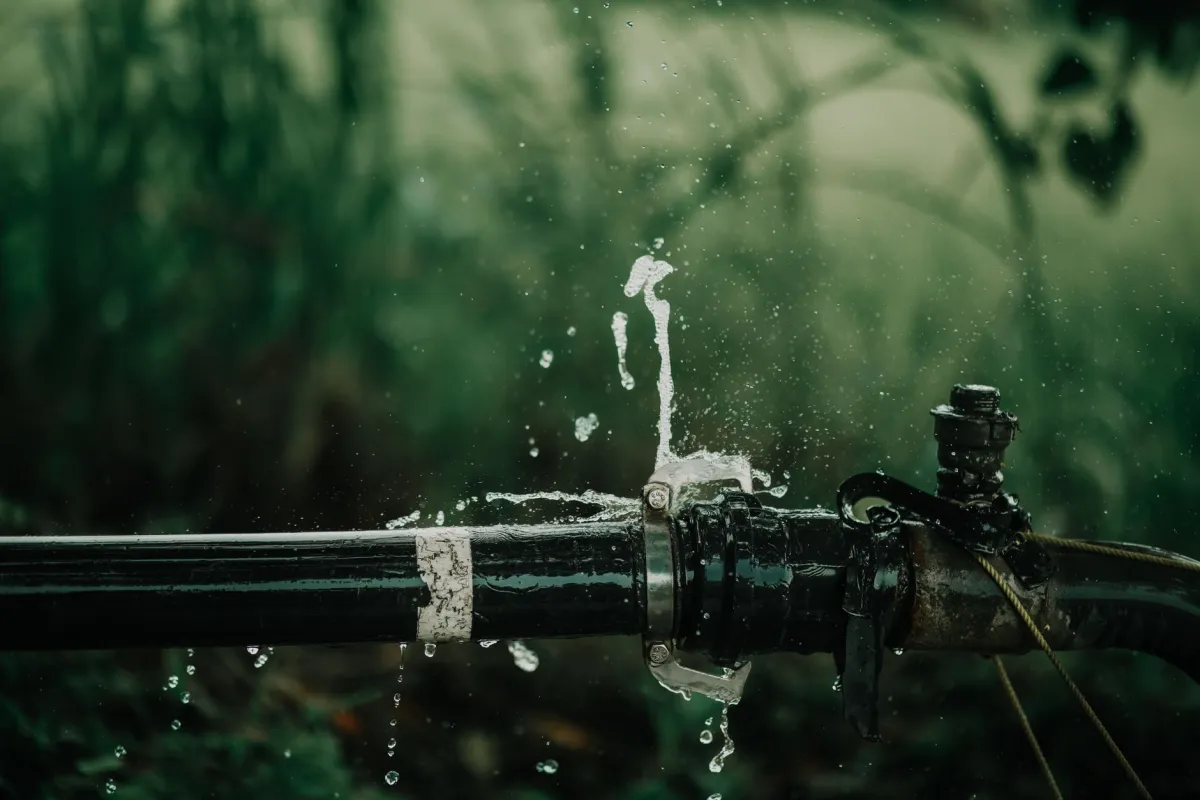
Water from the wall, the back of the tap or the tap body usually means frost damage. When the water trapped in an outside tap or the short pipe behind it freezes, it expands and can split the brass body or the copper pipe. The damage often goes unnoticed until the ice thaws and the tap is turned on, or until water starts running down the inside of the wall. If you see damp on the inside wall opposite the tap, or water running down the outside wall from behind the wall plate, isolate the supply straight away. A split in the pipe inside the wall can leak into the brickwork or the floor for weeks before it shows. Our guide to how to stop pipes freezing explains how to prevent it next winter.
A leak where a hose connects is usually the fitting, not the tap. Hose connectors have a rubber seal that wears and a thread that can be cross-threaded. Try a new connector before blaming the tap. If water sprays from the bottom of the tap body where there is a small screwed cap, that is often the built-in double check valve, which stops garden water siphoning back into your drinking supply. The Water Supply (Water Fittings) Regulations 1999 require outside taps to have backflow protection, so if the check valve has failed it should be replaced, not removed.
An outside tap giving no water at all has a short list of causes. The most common is simply that the isolating valve indoors was turned off for winter and never turned back on. The next is ice: in a cold snap, the tap or the pipe behind it may be frozen, and the water will return when it thaws, although you should check for splits once it does. A check valve can also stick shut, especially on a tap that has not been used for months, and limescale can block an old tap entirely. If the isolating valve is open and there is no frost, but the tap still gives nothing, the tap or its check valve needs replacing.
Some leaks need a plumber the same day. Call if water is running down the inside of a wall, if you cannot find a working isolating valve and have had to turn the whole house off, if the pipe behind the tap has split, or if the leak is near an electrical socket, outdoor light or garden lighting cable. Many Chelsea houses and mews have outside taps on the back wall of a basement or a lower ground floor kitchen, so a leak behind the wall there can reach the floor of the room below. Our outdoor plumbing repairs and burst pipe repair services cover both.
Replacing an outside tap is often the best fix for an old one. A new tap with a built-in double check valve, a proper isolating valve inside and insulated pipework through the wall gives you a tap that can be drained down each autumn and left safely over winter. If your existing tap was never fitted with an isolating valve, adding one is worth doing at the same time. Our guide to outside tap installation explains what a compliant installation includes, and our leaking tap repair service covers inside and outside taps alike.
Winterising stops most outside tap leaks from happening. Before the first frost, turn off the isolating valve indoors, open the outside tap to drain it and leave it open, and fit an insulated tap cover over it. If the pipe runs through an unheated garage or along an outside wall, lag it. In spring, close the outside tap, turn the isolating valve back on and check for drips before you connect a hose. Our guide to common winter plumbing problems lists the other checks worth doing before winter.
If your outside tap is leaking, split or giving no water, Emergency Plumber Chelsea can repair or replace it across Chelsea, Knightsbridge, Sloane Square, South Kensington and Fulham. We agree the work before we start, and there is no call-out fee on jobs over 3 hours. Call 020 3002 6667.
Quick tips
- Turn off the isolating valve indoors, usually under the kitchen sink, before any repair.
- A drip from the spout when off is the washer; a leak at the handle when on is the gland.
- Water from the wall behind the tap after a frost usually means a split pipe; isolate it now.
- Keep the double check valve; outside taps must have backflow protection.
- Each autumn, isolate the tap, drain it, leave it open and fit an insulated cover.
FAQs
Why is my outside tap dripping when it is turned off?
The rubber washer inside has worn or hardened, or the seat it presses against is damaged. Isolate the tap from inside, replace the washer and reassemble. If the seat is pitted, replacing the tap is usually the better fix.
Why is water leaking from the wall behind my outside tap?
Most often the pipe behind the tap or the tap body has split after freezing. Turn off the isolating valve indoors, or the main stopcock if there is none, and get the pipe repaired before water gets into the brickwork or the room behind.
Why is my outside tap not working?
Check the isolating valve indoors is turned on, because it is often left off after winter. If it is on, the tap may be frozen, or its check valve may have stuck or scaled up. A tap that stays dry once thawed and with the valve open usually needs replacing.
How do I turn off the water to an outside tap?
Look for a small isolating valve on the pipe feeding the tap indoors, usually under the kitchen sink or in a cupboard behind the wall the tap is on. Turn the slot or lever so it sits across the pipe. If there is no valve, use the main stopcock.
Can you repair outside taps in Chelsea?
Yes. We repair, replace and winterise outside taps across Chelsea SW3 and SW10, Knightsbridge, South Kensington and Fulham. Call 020 3002 6667.
Need an engineer in Chelsea?
Call 020 3002 6667 for 24/7 emergency dispatch across SW3, SW10 and nearby postcodes.