
— Chelsea advice
Gledhill Pulsacoil Problems and How to Fix Them
Most Gledhill Pulsacoil problems come down to one of four things: the store is not being heated (power, timer or a failed immersion element), the small pump that moves heat into your hot water has stopped, the plate heat exchanger has scaled up, or the float valve in the tank on top is letting water overflow. No hot water at all is usually power or the store; hot water that turns cold mid-shower is usually the pump or scale; water from an overflow pipe is usually the float valve or a leaking heat exchanger. You can check power, the timer and the store temperature yourself. The parts inside the case carry mains electricity and water at up to around 80°C, so leave those to an engineer. Emergency Plumber Chelsea covers SW3, SW10 and nearby postcodes on 020 3002 6667.
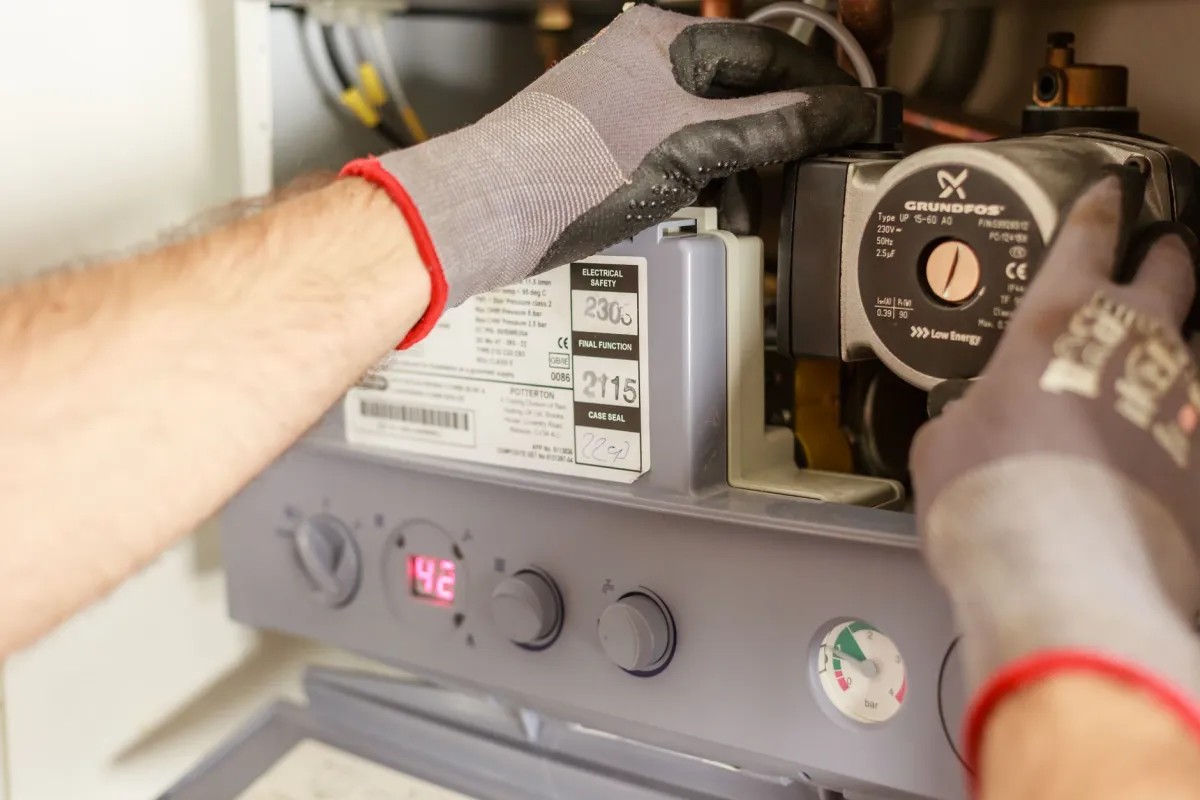
Updated July 2026 · Emergency Plumber Chelsea
How a Pulsacoil works, in plain terms. A Pulsacoil is a thermal store, not an ordinary hot water cylinder. The big tank holds water that is heated by electric immersion elements, usually overnight on a cheap off-peak tariff such as Economy 7, with a boost element for the daytime. That stored water never comes out of your taps. When you open a hot tap, a flow switch tells the controller, a small pump starts, and hot water from the store is pushed through a plate heat exchanger. Cold mains water passes through the other side of that heat exchanger and comes out hot, at mains pressure. There is a small feed and expansion tank on top of the unit that keeps the store topped up. Knowing those parts makes the faults below much easier to follow.
Why they are common in Chelsea and Fulham flats. Pulsacoils were fitted in large numbers in London flats with no gas supply, including conversions, purpose-built blocks and some mansion flats, because they give mains-pressure hot water from electricity without the rules that apply to an unvented cylinder. Many are now fifteen or twenty years old, and London's hard water is hard on them. If your flat has electric storage heaters or panel heaters and a tall white unit in a cupboard with a tank on top, it is probably a Pulsacoil or a similar thermal store.
No hot water at all: check the power and the timer first. Make sure the switches or isolators for the unit are on, and look at the consumer unit for a tripped circuit breaker or RCD. Most Pulsacoils have separate supplies for the off-peak element, the boost element and the controls, so one can be off while the others are on. Then check the timer or programmer. The clocks go back at the end of October, and off-peak meters often keep to their own schedule, so a timer that is out by an hour, or one that lost its settings in a power cut, can leave the store heating at the wrong time or not at all. If the store has had no heat overnight, pressing the boost should give you hot water within an hour or two.
Hot water that starts hot then turns cold. This is one of the most common Pulsacoil complaints. If the store itself is hot but the tap runs cold after a few seconds or a minute, the pump is the first suspect. Pumps wear out, stick after a period without use, or run weakly, and without the pump there is no heat moving into your hot water. The flow switch that starts the pump can also stick, so the pump never gets the signal. A failed pump is replaced as a part, and on most units it is a routine job for an engineer. If the pump is running but the water still will not stay hot, scale is the next suspect.
Weak flow, fluctuating temperature or hot water that is never quite hot. The plate heat exchanger is made of thin stainless steel plates with narrow channels, and in hard water areas like Chelsea those channels fill with limescale. Scale slows the transfer of heat, so the water comes out lukewarm, swings between hot and cool, or the flow drops. The heat exchanger can often be descaled, and if it is badly blocked or damaged it is replaced. Our guide to hard water and limescale in Chelsea explains why local water causes this, and fitting scale protection on the cold feed to the unit is worth discussing once it is clean.
Hot water runs out quickly or the store will not get hot. If the water is only warm from the first second, the store probably is not reaching temperature. The usual causes are a failed immersion element, a faulty element thermostat, or the off-peak supply not reaching the element. Many units have a temperature display or indicator lights that show how hot the store is; if it is low in the morning after a night on the cheap rate, the overnight heating has not happened. An element can be tested and replaced by an engineer. Our guide to a hot water immersion heater not working covers the element and thermostat faults in more detail, as the principles are the same.
Water coming out of an overflow pipe. The tank on top of the Pulsacoil has a float valve, much like a toilet cistern. If the valve sticks open or its washer wears, the tank keeps filling and water runs out of the overflow, often through an outside wall or into a tundish. A more serious cause is a leak inside the plate heat exchanger. Because the mains side is at higher pressure than the store, a pinhole between the plates lets mains water leak into the store, which then overfills and overflows even with a good float valve. A quick clue is an overflow that runs mostly when hot taps are being used. Either way, it needs sorting before the tank overflows into the cupboard or the flat below; our guide to overflow pipes that keep dripping covers the float valve side.
Pump running constantly, noises or error lights. A pump that keeps running with no tap open usually means a stuck flow switch or a control fault. Gurgling or rushing noises can mean the store is low on water, which points back to the feed tank on top. Flashing lights or error codes vary between models and generations, so note exactly what the display shows and the model name on the label before you call. That lets an engineer bring the likely parts first time.
What you can safely do yourself. Check the switches, circuit breakers and timer. Press the boost if you need hot water now. Look at the store temperature display if there is one. Note which taps are affected and whether the overflow is running. Turn off the cold supply to the unit if water is leaking and you know where the isolating valve is. Do not remove the front cover, touch the wiring, open the store or try to change the pump or heat exchanger yourself. There are live electrical parts and very hot water behind the cover, and a mistake can cause a scald, a shock or a flood.
Repair or replace? Many parts are still available for most Pulsacoil models, and a pump, heat exchanger, element or float valve replacement is usually far cheaper and quicker than replacing the whole unit. Replacement starts to make sense when the store itself is leaking, when several major parts have failed, or when parts for an early model are no longer available. At that point the options include a new thermal store, an unvented cylinder with a new discharge pipe, or on some properties a heat pump. Our guide to unvented and vented hot water cylinders explains the main alternative. If you are renting, the unit is normally the landlord's responsibility to repair, so report it to them or the managing agent in writing.
When to call an engineer. Call if the power and timer are fine and you still have no hot water, if the water runs hot then cold, if the overflow is running, if the unit is leaking into the cupboard, or if you can smell burning or see scorching on any switch or cable. Emergency Plumber Chelsea diagnoses thermal store faults, replaces pumps, heat exchangers, float valves and immersion elements, and tells you plainly whether repair is worth it. Our plumbing repairs service covers flats and houses across Chelsea, Knightsbridge, Sloane Square, South Kensington and Fulham, and our emergency plumber line is there if water is coming through a ceiling. Call 020 3002 6667. There is no call-out fee on jobs over 3 hours.
Quick tips
- Check every switch and circuit breaker for the unit first: off-peak, boost and controls are often on separate supplies.
- Reset the timer after the clocks change or a power cut, and check it matches your off-peak hours.
- Hot then cold at the tap usually means the pump or scale, not the store.
- An overflow that runs mainly when hot taps are used points to a leaking plate heat exchanger.
- Never take the front cover off. Live electrics and very hot water sit right behind it.
FAQs
Why has my Pulsacoil got no hot water?
Start with the power: check the switches and the consumer unit, as the off-peak, boost and control supplies are often separate. Then check the timer, especially after the clocks change or a power cut. If the store is hot but the taps run cold, the pump, flow switch or plate heat exchanger is the likely fault and needs an engineer.
Why does my Pulsacoil hot water go cold after a few seconds?
The pump that moves heat from the store into your hot water is usually the cause, either failing or not being switched on by the flow switch. A plate heat exchanger clogged with limescale can cause the same symptom. Both are replaceable parts.
Why is water coming out of my Pulsacoil overflow?
Either the float valve in the tank on top is not shutting off, or the plate heat exchanger has an internal leak that lets mains water into the store. If the overflow runs mostly when you use hot water, suspect the heat exchanger. Turn off the cold supply to the unit if you can and call an engineer.
Can a Pulsacoil be repaired or does it need replacing?
Most faults are repairable. The pump, plate heat exchanger, immersion elements, thermostats and float valve can all be replaced on most models. Replacement is usually only worth it if the store is leaking, several major parts have failed, or parts for an early model are no longer made.
Does a Pulsacoil need an annual service?
It does not store hot water under mains pressure, so it lacks the safety valves that make an unvented cylinder's regular check so important. A periodic check is still worthwhile, especially in hard water areas like Chelsea. Descaling the heat exchanger and checking the pump, elements and float valve before they fail is cheaper than an emergency call-out with no hot water.
Need an engineer in Chelsea?
Call 020 3002 6667 for 24/7 emergency dispatch across SW3, SW10 and nearby postcodes.